
Accounting Equation: a Simple Explanation
Reading time: 6 mins
What is the Accounting Equation?
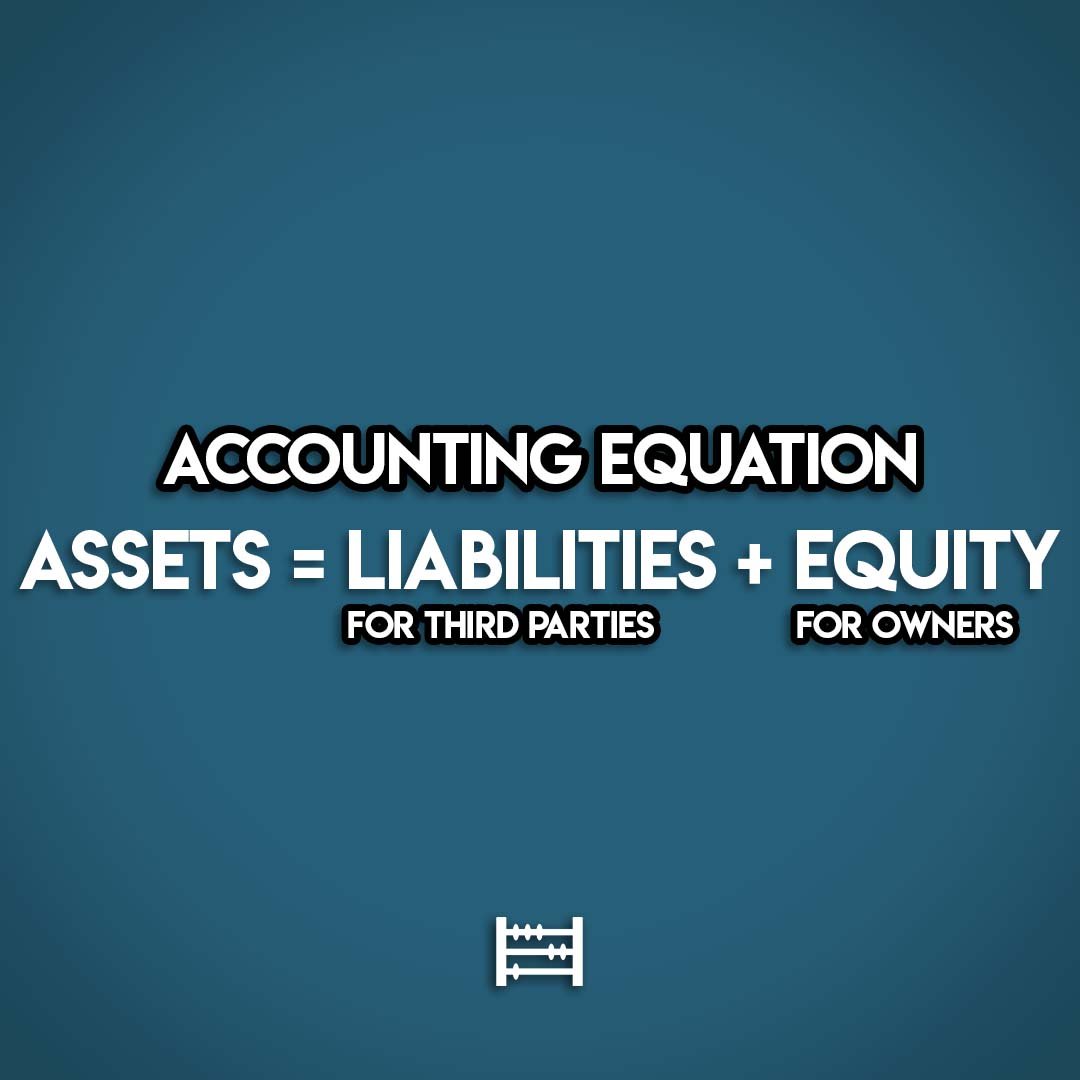
The Accounting Equation says that Assets are equal to Liabilities plus Equity.
Assets = Liabilities + Equity
This is a core principle of Accounting. The formula defines the relationship between a business's Assets, Liabilities and Equity. At any moment in time the Accounting Equation must balance. This lays the groundwork for Double-Entry Bookkeeping.
The Accounting Equation is also called:
the Accounting Equation Formula
the Balance Sheet Equation
Basic Accounting Equation
How does the Accounting Equation work?
The Accounting Equation tells us the stuff that a business owns is equal to the stuff that it owes.
Stuff that a business owns = Stuff that a business owes
A business owns Assets and owes Liabilities & Equity. Liabilities are owed to third parties, whereas Equity is owed to the owners of the business.

Which three components make up the Accounting Equation?
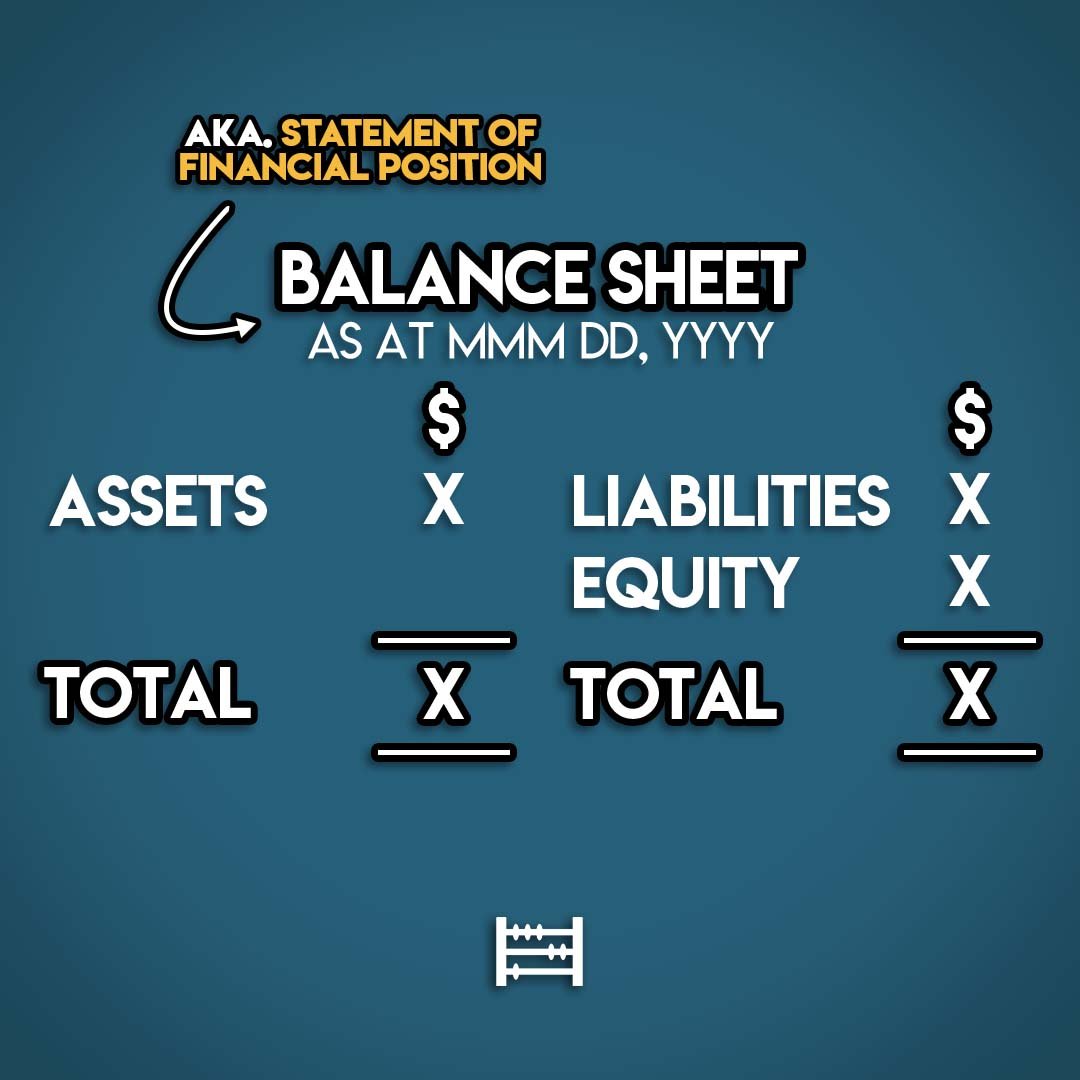
The accounting equation has three components: Assets, Liabilities and Equity. These are broken down on a business's Balance Sheet. The Balance Sheet is a Financial Statement that gives us a snapshot of a business's Assets, Liabilities and Equity at a point in time.
Let's take a closer look at each of these elements so that we can understand them better.
Assets
Assets are the stuff that a business owns that have value. They make up one side of the Accounting Equation. You can think of them as resources that a business controls due to past transactions or events. Assets can be current or non-current.

Current Assets
Current Assets are Short-Term Assets. These are expected to be converted into cash in under one year. They include:
Cash
Short-Term Investments
Accounts Receivable
Inventory
Accrued Revenue
Prepaid Expenses
Non-Current Assets
Non-Current Assets are Long-Term Assets. These aren't as easy to convert into cash. They are expected to be held for more than one year. They are made up of:
Long-Term Investments
Property, Plant & Equipment
Intangible Assets
Liabilities
Liabilities are the stuff that a business owes to third parties. Along with Equity, they make up the other side of the Accounting Equation. Liabilities are a business' obligations to third parties. They require a sacrifice of economic benefit in the future. Liabilities can also be Current or Non-Current.

Current Liabilities
Current Liabilities are Short-Term Liabilities. These are a business's obligations that need to be settled within one year. They include:
Accounts Payable
Salaries Payable
Taxes Payable
Accrued Expenses
Deferred Revenue
Short-Term Debt
Non-Current Liabilities
Non-Current Liabilities are Long-Term Liabilities. These are obligations that aren't expected to be settled within one year. These are some common examples of Long-Term Liabilities:
Long-Term Debt
Notes Payable
Equity
Equity is the stuff that a business owes to its owners. If we rearrange the Accounting Equation, Equity is equal to Assets minus Liabilities. Net Assets is the term used to describe Assets minus Liabilities.
Equity = Assets - Liabilities = Net Assets

So Equity is the owner's claim on the Net Assets of a business. It's made up of:
Capital Contributions
Retained Earnings
Accounting Equation Example
Let me show you how the Accounting Equation works with an example.
Storyteller's Corner is a bookstore. On December 31st, 20X5 they reported the following numbers on their Balance Sheet:
Total Assets: $100,000
Total Liabilities: $70,000
Total Equity: $30,000
On the left side of the Accounting Equation Storyteller's Corner has Total Assets of $100,000. On the right, they have Total Liabilities of $70,000 and Total Equity of $30,000. This adds up to $100,000 ($70,000 + $30,000). This matches their Total Assets on the left of the Accounting Equation.
Total Assets = Total Liabilities + Total Equity

What is Double-Entry Accounting?
In Double-Entry Accounting, there are at least two sides to every financial transaction. Every accounting entry has an opposite corresponding entry in a different account. This principle ensures that the Accounting Equation stays balanced.
For example, imagine that a business's Total Assets increased by $500. This change must be offset by a $500 increase in Total Liabilities or Total Equity.
Debits and Credits are the words used to reflect this double-sided nature of financial transactions.
What is the Expanded Accounting Equation?
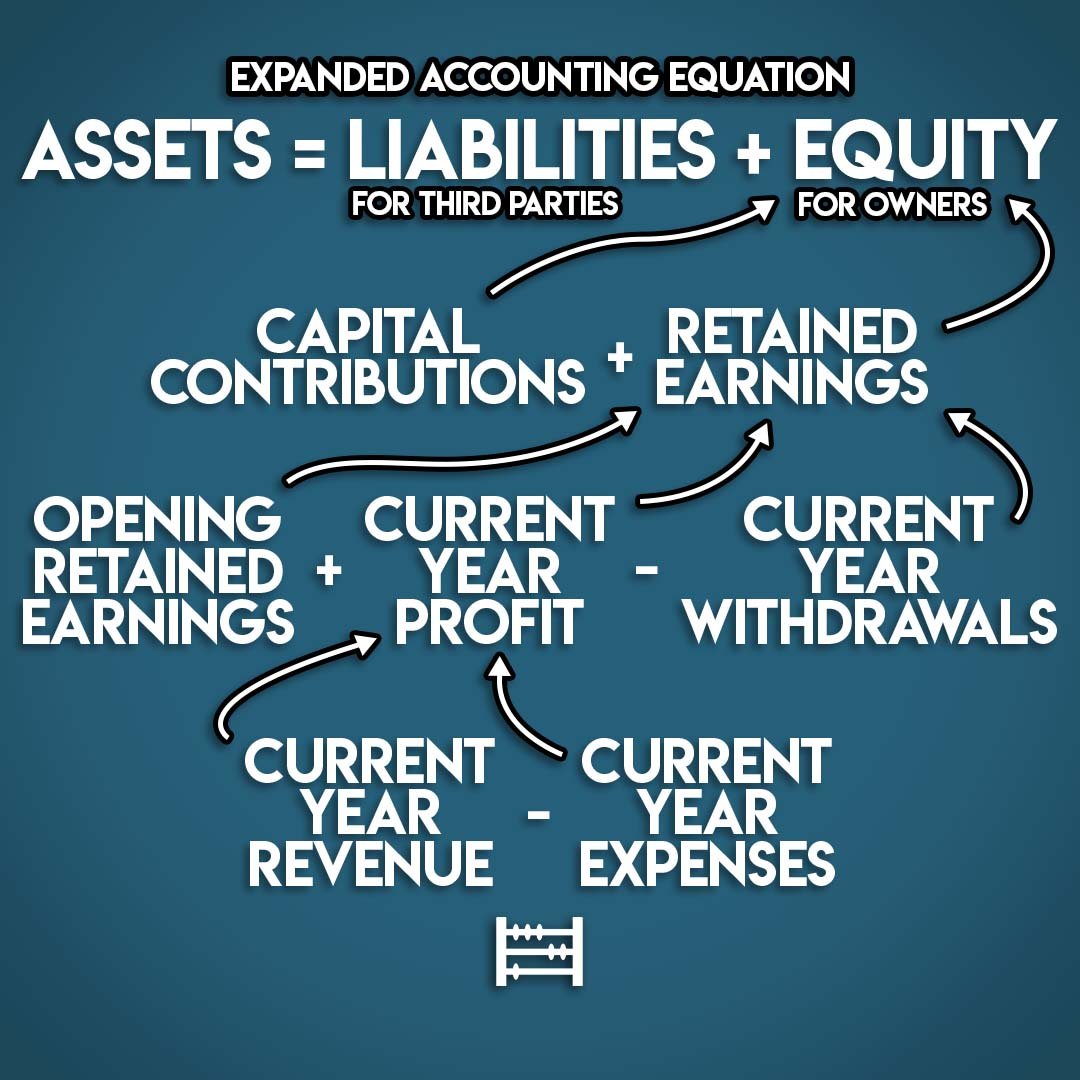
The Expanded Accounting Equation breaks Equity down into its core components. These include:
Capital Contributions: Funds invested into the business out of the owner's own pocket.
Opening Retained Earnings: Profits held for future use at the start of the accounting period.
Revenue: Income earned during the current year
Expenses: Costs incurred during the current year
Withdrawals: Earnings distributions the business owners during the current year
The Expanded Accounting Equation is:
Assets = Liabilities + Capital Contributions + Opening Retained Earnings + Revenue - Expenses - Withdrawals
This is the same as the Basic Accounting Equation but it contains more detail on the sources of Equity.
Key Points
The basic Accounting Equation is: Assets = Liabilities + Equity
Assets are the stuff that a business owns that have value.
Liabilities are the stuff that a business owes to third parties.
Equity is the owner's claim on the Net Assets of a business.
A Balance Sheet is a snapshot of the Accounting Equation at a point in time.
This formula is the backbone of Double-Entry Accounting.
The Expanded Accounting Equation breaks Equity down into its core components.
More Accounting Equation Resources
Accounting Equation Video
In this short video I summarize how the Accounting Equation works:
Accounting Equation Practice Questions
You can test your understanding of the Accounting Equation in this short quiz:
I have also made an Accounting Equation Practice Question Pack which you can buy here:

Accounting Equation Practice Questions
This Question Pack contains 25 practice questions and answers on the Accounting Equation. You can use them to test your knowledge of this key concept in Accounting. Alongside each question is a full written explanation of the answer. Feel free to print, annotate and add them to your notes.
What is in the Accounting Equation Question Pack?
The Accounting Equation Question Pack contains 25 practice questions and answers. You'll receive the following documents:
Accounting Equation Question Pack 1.pdf (2 Pages)
Accounting Equation Answer Pack 1.pdf (5 Pages)
How will I receive my Accounting Equation Cheat Sheet?
The Accounting Equation Question Pack is a digital product. After completing your purchase you'll receive an email. It will contain a link to download a .zip file which contains your .pdf files.
If you run into any issues then please contact me here. I’ll get back to you as soon as possible.
Can I share my Accounting Equation Question Pack?
This Question Pack is for personal use only. Please don’t share with others.
Our digital products are copyright © Accounting Stuff Pty Ltd. They are for personal use by the original purchaser only. We do not allow our digital products to be reproduced or distributed elsewhere.
All prices are in USD.