
Double-Entry Accounting Practice Quiz
Double-Entry Accounting: 20 Practice Questions for Beginners
How well do you know Double-Entry Accounting? Let’s find out!
In this video, I’ll quiz you on Double-Entry Accounting with 20 multiple choice questions.
You know the drill! Grab a pen, play along and remember to share your score in the comments at the end.
What does the word “entry” mean in Double-Entry Accounting?
a) A note written in the company diary about daily operations
b) A single record of a financial transaction
c) Entering the office at the start of the day
d) Filing receipts in a folder
Single-Entry Accounting and Double-Entry Accounting are both ______. Can you fill in the blank?
a) Bookkeeping Systems
b) Financial Statements
c) Methods of calculating tax
d) Cost Flow Assumptions
In Single-Entry Accounting, a transaction is recorded once ______. Can you fill in the blank?
a) As a debit
b) As a credit
c) In a Revenue account
d) In a Cash account
In Double-Entry Accounting, every accounting entry must ______. Can you fill in the blank?
a) Be recorded once in the Cash account
b) Be recorded twice in a Cash Book
c) Be recorded only when cash is received or paid out
d) Have an opposite corresponding entry in a different account
Which core concept is the foundation of Double-Entry Accounting?
a) The Cost Principle
b) The Matching Principle
c) The Accounting Equation
d) The Revenue Recognition Principle
What is the main advantage of Double-Entry Accounting over Single-Entry Accounting?
a) It requires fewer records and less effort
b) It provides a complete financial picture
c) It only tracks cash transactions
d) It removes the need for financial statements
The balance of a T-Account is calculated by ______ . Can you fill in the blank?
a) Adding all debits
b) Adding all credits
c) Adding both sides together
d) Subtracting the smaller side from the larger side
In Double-Entry Accounting, every financial transaction affects ______ . Can you fill in the blank?
a) Only one account
b) Exactly two accounts
c) At least two accounts
d) More than two accounts
Which terms represent the two sides of Double-Entry Accounting?
a) Debits and Credits
b) Assets and Liabilities
c) Revenue and Expenses
d) Profit and Loss
Who is credited with popularising Double-Entry Accounting?
a) Luca Pacioli
b) Leonardo da Vinci
c) Giovanni Fontana
d) Adam Smith
Can you tell me the name of his famous book?
a) The Wealth of Nations
b) Summa de Arithmetica
c) Principles of Accounting
d) There and Back Again
By convention, where do Debits and Credits go in an account?
a) Debits go on the top and Credits go on the bottom
b) Debits go on the bottom and Credits go on the top
c) Debits go on the right and Credits go on the left
d) Debits go on the left and Credits go on the right
Debits increase the balance of which account?
a) Cash
b) Accounts Payable
c) Owner’s Capital
d) Service Revenue
Credits increase the balance of which account?
a) Accounts Receivable
b) Inventory
c) Cost of Sales
d) Accrued Expenses
Credits decrease the balance of which account?
a) Taxes Payable
b) Interest Income
c) Owner's Drawings
d) Owner’s Capital
Debits decrease the balance of which account?
a) Land and Buildings
b) Prepaid Expenses
c) Overhead Expenses
d) Retained Earnings
A business receives a $600 electricity bill but hasn’t paid it yet. It credits Accounts Payable by $600 to record the amount owed on the Balance Sheet. What is the other entry?
a) Debit Utility Expenses $600
b) Debit Cash $600
c) Debit Equipment $600
d) Debit Drawings $600
A business buys equipment for $2,000, paying the full amount in cash. It debits Equipment by $2,000 to record the new asset on the Balance Sheet. What is the other entry?
a) Credit Accounts Payable $2,000
b) Credit Cash $2,000
c) Credit Revenue $2,000
d) Credit Retained Earnings $2,000
A business sells services worth $1,000 on credit. It credits Service Revenue by $1,000 to recognize the income earned on the Income Statement. What's the other entry?
a) Debit Cash $1,000
b) Debit Accounts Receivable $1,000
c) Debit Unearned Revenue $1,000
d) Debit Accounts Payable $1,000
A business pays $800 to a supplier to settle an outstanding debt. It credits Cash by $800 which decreases its Assets on the Balance Sheet. What is the other entry?
a) Debit Accounts Payable $800
b) Debit Accounts Receivable $800
c) Debit Supplies Expense $800
d) Debit Owner’s Capital $800
Bonus Question! Which year did Luca Pacioli publish the Summa de Arithmetica?
a) 1394
b) 1494
c) 1594
d) 1694
Scroll down to see the answers.
Debits and Credits Cheat Sheet
Click here to download my Debits & Credits Cheat Sheet. It’s a quick reference guide that lays out everything you need to know about Double-Entry Accounting.
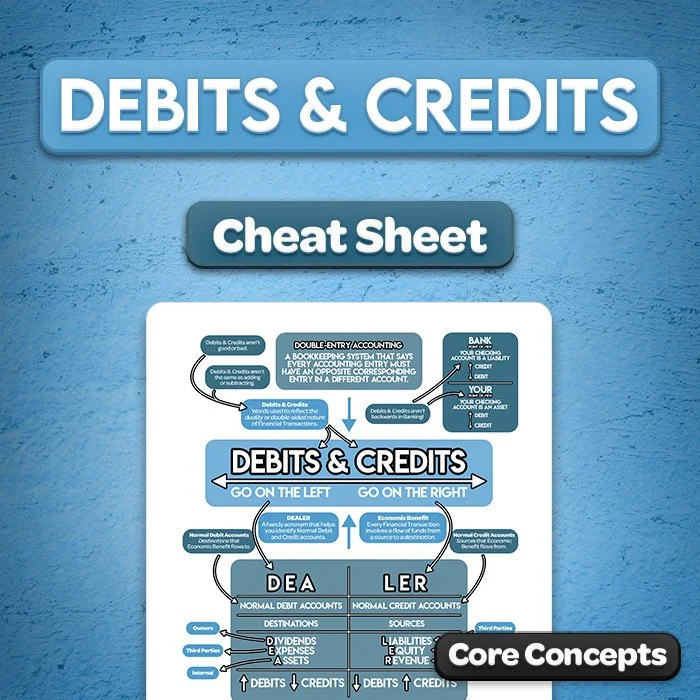
Build your understanding of Debits and Credits with this clear, beginner-friendly cheat sheet. This one-page visual guide brings the key concepts together in one convenient reference that you can view on screen, print, annotate or add to your study notes.
It also summarizes the key information from my Debits and Credits video, making it ideal for reviewing the topic after watching.
All prices are in USD.
Double-Entry Accounting Quiz: Answers
Here are the answers:
b) A single record of a financial transaction. An entry is how we record a transaction in an accounting system.
a) Bookkeeping Systems. A bookkeeping system is a method used to record and organise a business’s financial transactions.
d) In a Cash account. Single-Entry Accounting is a cash-based system. Revenue is recorded when cash is received, and expenses are recorded when cash is paid out.
d) Have an opposite corresponding entry in a different account. In Double-Entry Accounting, every entry has to balance.
c) The Accounting Equation. The Accounting Equation is the backbone of Double-Entry Accounting.
c) Assets = Liabilities + Equity. The Accounting Equation essentially tells us the stuff that a business owns is equal to the stuff that it owes to external parties and its owners.
b) It provides a complete financial picture. Double-Entry Accounting records both sides of every transaction. This allows businesses to track Revenues and Expenses on the Income Statement, and Assets, Liabilities and Equity on the Balance Sheet.
c) At least two accounts. In Double-Entry Bookkeeping, every transaction affects two or more accounts, and the total of both sides always has to balance.
a) Debits and Credits. Debits and Credits are words used to reflect the duality of financial transactions.
a) Luca Pacioli. Double-Entry Accounting was developed over time by Italian merchants in 14th and 15th century. While Luca didn’t invent the system, he was the first person to document it, which is why we call him the “Father of Accounting.”
b) Summa de Arithmetica. Luca Pacioli wrote the Summa de Arithmetica, Geometria, Proportioni et Proportionalità. This roughly translates to the summary of Arithmetic, Geometry, Proportions, and Proportionality.
d) Debits go on the left and Credits go on the right. If you imagine a scale, this keeps transactions nicely in balance.
a) Cash is a type of Asset, represented by the "A" in DEALER. This means it's a Normal Debit Account, so debits increase it and credits decrease it.
d) Accrued Expenses. Don't be fooled by the name! Accrued Expenses are Liabilities, represented by the "L" in DEALER. This means they're Normal Credit Accounts, so credits increase them and debits decrease them.
c) Owner's Drawings. Drawings or Dividends are represented by the "D" in DEALER, so they're Normal Debit Accounts. That means credits decrease them.
d) Retained Earnings are a business's accumulated profits held for future use. It's an Equity account, which means it's the second "E" in DEALER, so a Normal Credit Account. This means debits decrease Retained Earnings.
a) Debit Utility Expenses $600. The business debits Utility Expenses to record the cost incurred on the Income Statement.
b) Credit Cash $2,000. There's been a cash outflow, so we credit Cash to decrease Assets on the Balance Sheet.
b) Debit Accounts Receivable $1,000. The sale was made on credit, which is like an “I owe you.” So the business debits Accounts Receivable to record the amount owed by the customer on the Balance Sheet.
a) Debit Accounts Payable $800. The payment reduces the amount the business owes to its supplier, so it debits Accounts Payable to clear the Liability on the Balance Sheet.
b) 1494. He published it in 1494, at the start of the High Renaissance.
How many did you get right? Let us know your score in the comments below.
Double-Entry Accounting: Video Tutorial
Are you interested in learning more about Double-Entry Accounting? I break the concept down in this video:
In this video, I attempt to explain how Double-Entry Accounting works in less than two minutes.